
Note: This article was adapted from a book we prepared for Latere for the 2023 FIEE. ART3673S ART5283
If you already work with electronics, you are a student, a teacher, a maker, or in other groups that may be associated with this book, we will provide important tips to help you have the best workbench available today. The electronics workplace (a term we will use from now on) has evolved as much as electronics itself. In the past, anyone wanting to work on projects needed a very large space, as the equipment covered a variety of areas such as carpentry, mechanics, chemistry, and, of course, electricity.
We needed bench drills, metal benders, hammers, table vises, carpentry tools, and even chemical resources. These were garage laboratories, and in some cases, they became extremely large as more and more was needed, taking Thomas Edison's laboratories as an example. Larger than many factories with many employees.
However, electronics has evolved significantly, and in addition to no longer necessarily including other activities such as mechanics, chemistry, and biology in the workplace, it has also become smaller. Makers' workplaces have been shrinking, and today, their worktables or benches can be much smaller, with dimensions that can be easily adapted to each individual's needs, ranging from a small room in a home to a small corner or table in an apartment.
Choosing the right countertop and what to place on it requires careful consideration, as the relationship between size and space depends on your intended use. Therefore, our tips should be carefully considered by each individual to adapt their desired countertop to their intended use and achieve maximum results.
Therefore, the suggestions are flexible, offering variations that adapt to each individual. However, they serve as a starting point if you are still a student and intend to become a professional, or if you are already a professional and need to expand your work, or if you are retired and want to work from home in a new activity, whether for recreational purposes or to increase your income.
There is nothing more unpleasant than having to solder a wire to a board and discovering that your workbench does not include a device to hold the board in the correct position so you can hold the soldering iron on one and the solder on the other. Cost-benefit based on your needs will be our main focus, equipping your workbench with the best and most advanced equipment available at the time of writing.
1. Choosing a Workspace
These days, finding a suitable place to set up a workbench isn't easy. Lucky are those who still live in spacious properties in the countryside, where they can easily find a spacious and ventilated space in a shed or a larger room. Even bedrooms are larger, with enough space for a good-sized workbench.
Some basic considerations are important when choosing the location of your workbench. This choice also determines the type and size of your workbench. The main points to consider when choosing it are:
- A location where I feel comfortable and will not be disturbed by pedestrians (or animals)
- The location should be well ventilated, with resources to eliminate any welding fumes I may use.
- The location should preferably have natural light and supplemental local lighting. Use well-positioned light sources, such as small lamps, if you need greater visibility.
- Cleaning the workbench area and the workbench itself should be easy.
- Avoid positioning the workbench in walkways where corners could cause injury to passersby.
- Find a quiet place for your installation so it does not interfere with your work or any recordings or live streams you may do to display your projects.
- Consider positioning that facilitates the use of resources to display or record your work for videos.
- If you have problems with small children or animals climbing on the countertop, consider installing a protective enclosure. You do not want to see your cat get mauled when you leave an appliance on and go out for a coffee.
- It is essential to have a location with access to electrical power.
- If you intend to use the countertop for professional work, consider a location where there's room for expansion, additional benches with both instrumentation and mechanical capabilities, or even multiple benches to perform simultaneous work.
- Have tools and equipment appropriate for the type of work you're doing.
In addition, for those who live in apartments, it's a good idea to check the regulations regarding noise and other forms of emissions that could affect the neighborhood, in case you plan to develop that 800W audio amplifier or repair one at night and, of course, emit smelly solder fumes or burnt components that reach neighboring apartments.
2. Safety and comfort for the user – ventilation and lighting – Lenses
The first point to consider is safety. You'll be working with electricity, and electricity kills. Just because you intend to work with microcontrollers and low-voltage circuits does not mean you should neglect this aspect.
Everyone who works with electricity should know how to handle something that can be dangerous. Therefore, understanding what an electric shock is, how to avoid it, and knowing what to do when someone is seriously affected by one should be necessary for any maker.
Benchtop Protection – RCD Devices
A benchtop must be safe, and several resources can be used to achieve this. Of course, safety begins at the point where the electrical energy enters your home. Therefore, protection must also be present at the entrance. An important resource that must be considered and that complements the protection provided by fuses and circuit breakers is residual current devices.
Detecting Leaks
Residual current devices are based precisely on the fact that the current intensity must be the same at all points in an electrical circuit. This will only be disrupted if an element outside the circuit diverts part of the current, causing the currents in both the hot and return (neutral) wires to change and become different.
Next figure shows what happens if someone touches one of the wires in an electrical installation, resulting in a shock from the current that passes through their body and into the ground.
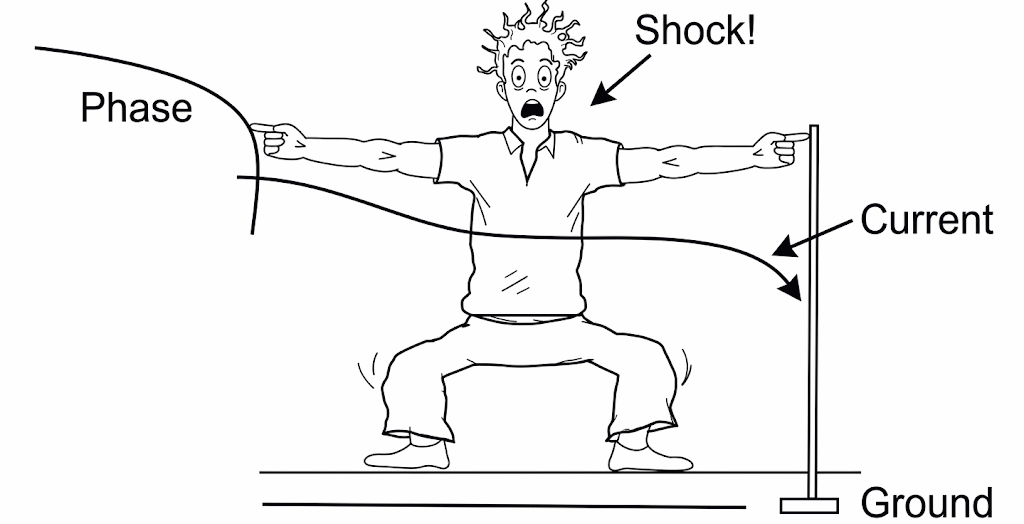
Thus, a simple way to detect shocks, leaks, or other problems in a circuit is to compare the currents in the two wires in the installation. If the currents are the same, then we can say that the circuit is in order and that only the load is receiving power. However, if the currents differ in intensity, then we can say that there is a leak, a short to ground, or someone is being shocked, causing a current deviation.
This is exactly what a Residual Current Device (RD) or DDR (Residual Current Device) does. It compares the two currents and when they become unequal, it shuts down the circuit. For common RD devices, the sensitivity is usually around 30 mA. Next figure shows how this can be done using a current transformer and a voltage comparator.
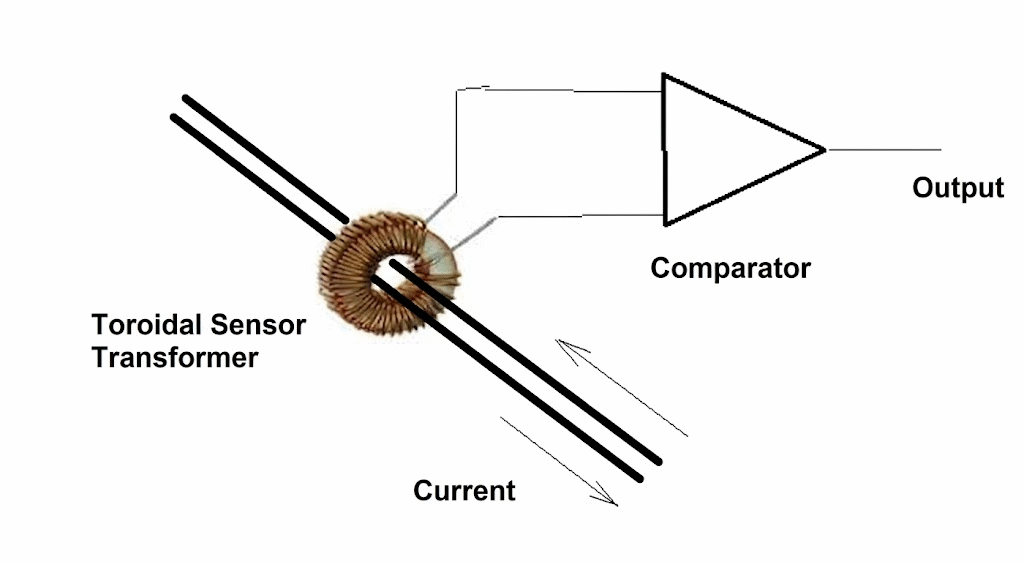
In this circuit, if the current intensities are equal, the output will be zero. If the intensities are different, we will have an output voltage.
This output voltage can then be used to trigger a relay or circuit breaker that trips the circuit until the cause of the leak is removed, or by requiring manual reset.
Note that the device operates with the magnetic field of the current flowing through the wire, which induces a voltage in the turns of the toroid coil. Thus, circuit losses are virtually non-existent. The current in the circuit is unaffected. Next figure shows what such a device looks like, incorporating the sensor system and the trip circuit.
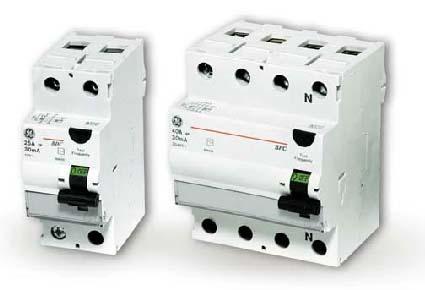
Installing the device is very simple. Simply insert it into the input of the electrical circuit to be protected. Having one of these devices at the input on your workbench is essential for your safety, monitoring all the devices you work with.
Specifications
Residual currents can typically range from 10 mA to 300 mA, and for short-circuit protection, we have additional protection: a circuit breaker, specified in amperes. Values in the range of 16 to 125 A are common in commercial and residential installations.
For a workbench, the choice of current will depend on the type of work you will be performing. For work with low power, electronics, typically under 500 W, smaller types with 16 A are appropriate. If you intend to work with power electronics, involving motors, heating elements, and inverters, it will be convenient to have higher protection.


