
The simplest oscillator configuration with an operational amplifier, which can generate both rectangular and serrated signals, is shown in figure 1.
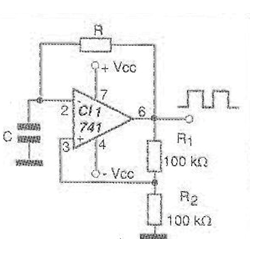
It is a relaxation oscillator in which the frequency is determined by the feedback resistor and the capacitor connected to the inverting input. With the components shown in this circuit the frequency will be of the order of 1 kHz.
R can have values between 10 k ohms and 1 M ohm typically and for the capacitors the values are given only in function of the frequency limits at which the oscillator can oscillate. Values between 1 nF and 100 uF can be used. In order to obtain an adjustable frequency oscillator with the same configuration, we added two potentiometers, one for adjusting the symmetry of the signal and another for the frequency, as shown in figure 2.
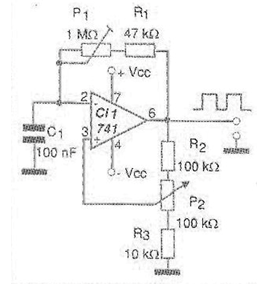
This circuit can generate signals from 250 Hz to 2500 Hz. A printed circuit board for the second circuit is shown in Figure 3.
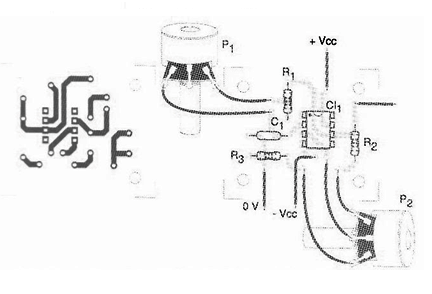
For operational amplifiers such as the 741 the power can be made with symmetrical source from 6 V. Other types can operate with lower voltage power supplies.
The maximum frequency that this circuit can generate is around 1 MHz.
Material list
(Circuit 1)
CI-1 - 741 or equivalent - operational amplifier
R - 100 k ohm - resistor (see text)
C - 10 nF - ceramic or polyester capacitor - see text
R1, R2 - 100 k ohm - resistors
More:
Printed circuit board, symmetrical power supply, wires, solder, etc.
(Circuit 2)
CI-1 - 741 or equivalent - operational amplifier
R1 - 10 k ohm x 1/8 W - resistor
R2 - 100 k ohm x 1/8 W - resistor
R3 - 10 k ohm x 1/8 W - resistor
P1, P2 - 100 k ohm - potentiometer
C1-22 nF - ceramic or polyester capacitor
More:
Printed circuit board, symmetrical power supply, wires, solder, etc.


