
While AM broadcasts tend to disappear, just like the receivers, an old radon that has the shortwave range is still good for experiments and interesting demonstrations. With it we can demonstrate how telegraph transmissions work, which has been widely used with efficient means of long distance communications for many years, especially between the 1920s and the 1970s.
Transmissions in this range, which are still used by amateurs and in special services, can reach thousands of kilometers under special conditions of propagation. We now describe a simple continuous wave (CW) transmitter that will have its signals picked up at a radon located at distances that depend on the sensitivity of the receiver and the antenna. The circuit will operate in frequency between 2 MHz and 15 MHz.
The circuit basically consists of a Hartley oscillator in which the frequency is determined by the coil L1 and the variable CV.
In figure 1, we have the transmitter diagram that operates in CW (See CW and telegraphy in our almanac to find out more).
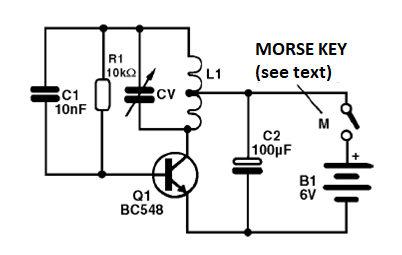
The coil is formed by 20 to 40 turns of enameled wire 28 or thinner, or common plastic jacket wire 22 with a socket in the central turn. With fewer turns the frequency will be higher. Test your radius to see the best track in your location.
The shape is a ferrite rod of 0.8 to 1 cm in diameter and 15 to 30 cm in length. The variable capacitor can be harnessed from any AM radio with capacitance between 120 and 310 pF.
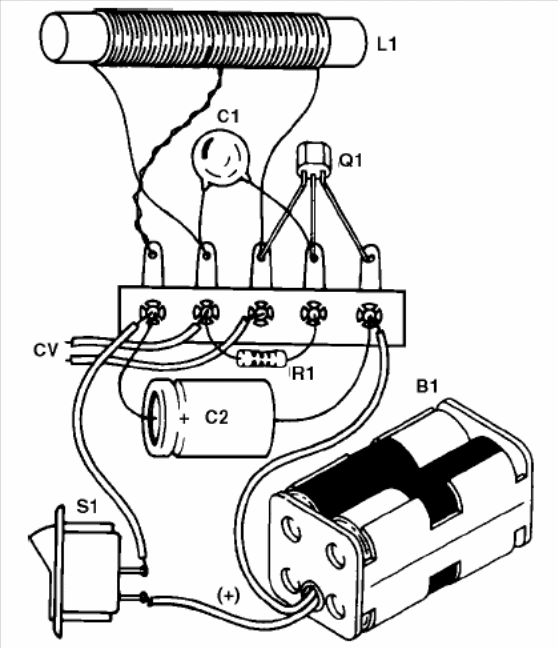
In figure 2 we have the experimental assembly made on a terminal strip.
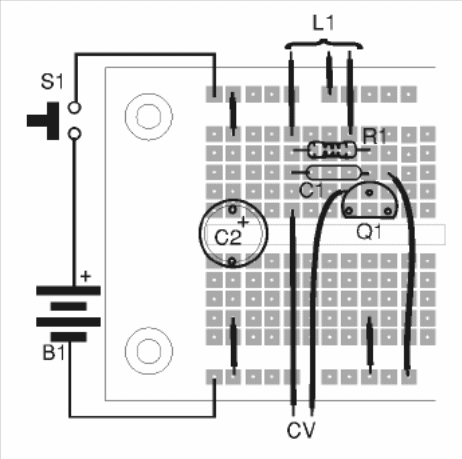
In figure 3 the arrangement of the components in a protoboard.
To test the device is simple: connect an AM radio off-station near the chosen shortwave band nearby. Then adjust the CV variable of the transmitter until it picks up a kind of "blow", which is the RF carrier.
Interrupting this carrier with a manipulator in the circuit, or even through the switch can encode the signal, transmitting in Morse code (telegraphy). This is the principle of many transmitters. You can use this experimental montage in science fairs for demonstrations.
You can attach to the collector an antenna, consisting of a wire stretched from 3 to 10 meters in length. With this, the reach will be much greater.
Wireless Technology
A very fashionable word in technical terms today is "wireless." The tendency is that all the equipment we have in our homes communicate through radio waves or other types of signals.
So-called "radio links" using technologies such as "Bluetooth" are intended to send information from one computer to another by means of radio waves. A computer is then connected to a transmitter that sends its signals to a distant receiver. The receiver processes the signals and sends them to another computer that can then receive them.


