
With this simple circuit you can control the brightness of a small lamp powered by battery, source or battery.
One of the applications for this circuit is in controlling the brightness of the car dashboard lamps. Interleaved between the source (battery) and the lamp, this circuit allows a control of brightness from zero (erased) to the maximum, without consumption problems. The circuit is very simple and uses only one transistor.
In figure 1 we have the complete circuit based on a transistor TIP31.
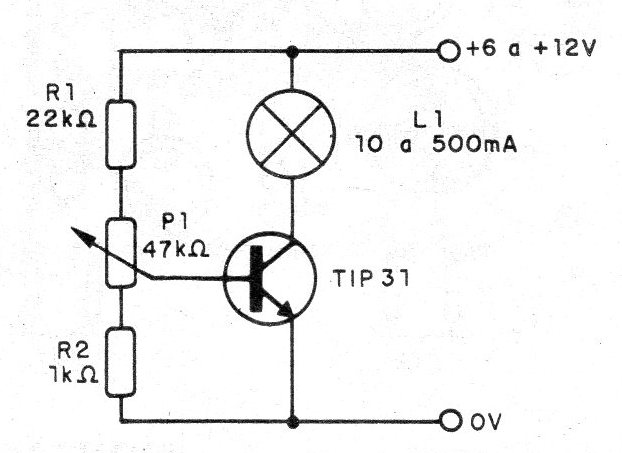
With the polarity reversal of the power supply we can use PNP transistors without modifying the circuit. Under these conditions transistors such as TIP32, AD162, and others may be used.
The transistor must be mounted on a small heat radiator consisting of a small screwed screw in its housing, in contact with the metal part. The 47 k ohm potentiometer can stay away from the circuit (up to 2 meters) which is important in the case of its attachment to a car dashboard.
The resistor R1 as a function of the gain of the transistor can be changed in the range of 10 to 100 K ohm to obtain a better variation in the potentiometer action. The lamp should not have a consumption greater than 500 mA and its working voltage should be the same as that used in the power supply, between 6 and 12 V.
Please note that this circuit does not operate with alternating current and higher voltages, under penalty of damage to components. The assembly, made on a printed circuit board is shown in figure 2.
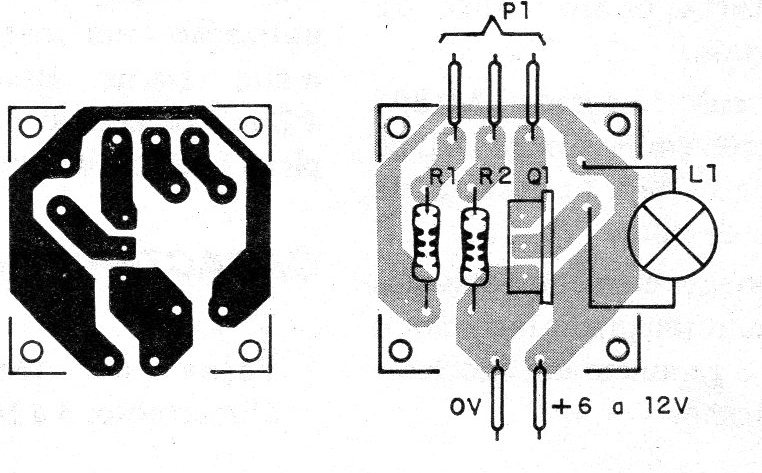
In this drawing the L1 connection wires are soldered directly to its base, but if it is possible to use a socket it is better. In the car, the 12V wire is connected to any point where we have this voltage in the fuse box and the 0V wire is connected to any point on the chassis.
Material list
Q1 - TIP31 or any NPN power transistor
P1 - 47 k ohm - potentiometer - (lin or log)
Resistors: (1/8 W, 5%)
R1 - 22k ohm
R2 - 1k ohm
Miscellaneous: printed circuit board, heat radiator, wires, solder, knob for pot, etc.


