
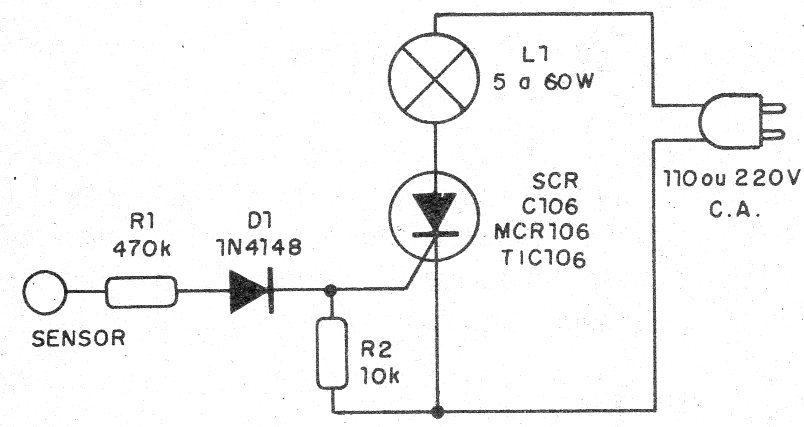
By touching the sensitive element of this sensor, an incandescent lamp lights up, or a buzzer rings if this is the reader's choice. The circuit has no latch and can be used as a small experimental alarm with very few components.
A touch on the sensor and the current flowing through our body is enough to trigger the LDR that lights an incandescent light bulb or even rings a bell.
The circuit is very sensitive, but great care must be taken with its use because it is not isolated from the power grid.
On the other hand, the R1 resistor of very high value prevents an intense current from flowing by the person touching it, which would cause a dangerous shock.
The circuit should be used with knowledge of the risks of its use and should not trip bulbs or electronic devices.
In figure 1 we have the complete diagram of the touch switch.
In figure 2 we have its assembly that, being quite simple and elementary, makes use of a small terminal strip.
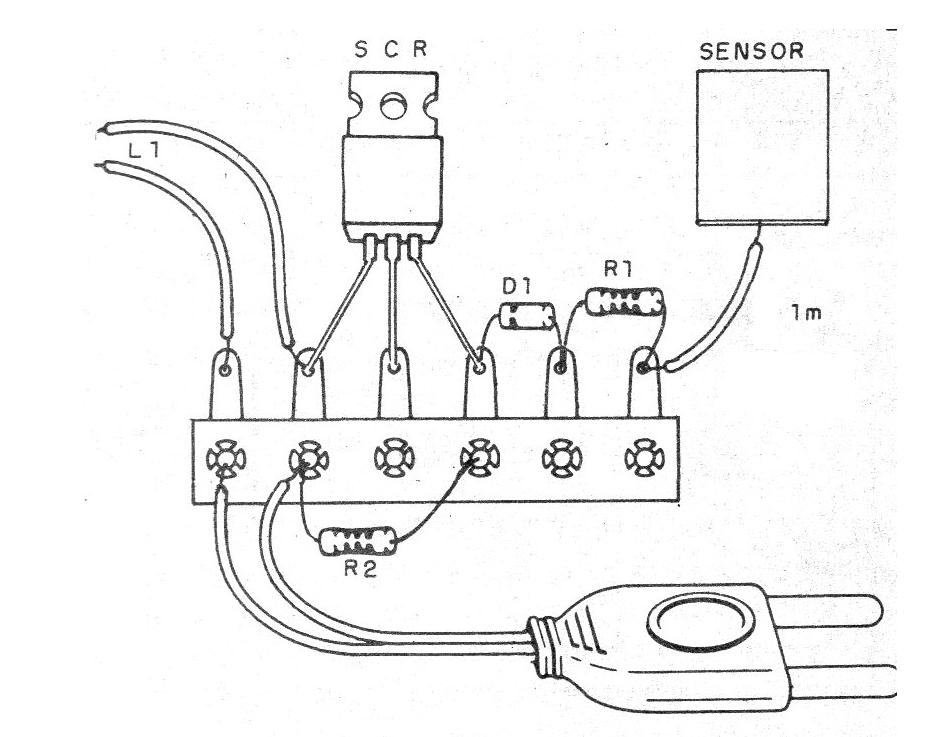
The sensor consists of a metal plate or may be the very tip of the peeled wire, attached to the resistor.
The appliance must be enclosed in a plastic or wooden box to avoid contact with any living parts.
To use, connect the circuit to the power grid and touch the sensor. If the lamp does not come on, turn the plug 180 degrees.
Material list
SCR - TIC106B or D depending on the network is 110 V or 220 V
D1 - 1N4004 - silicon diode
R1 - 470k x 1/8 W - resistor - yellow, violet, yellow
R2 - 10 k ohms x 1/8 W - resistor - brown, black, orange
L1 - 4 to 60 W incandescent lamp
Several:
Power cable, socket for lamp, terminal strip, wires, solder, sensor, etc.


