
In fact, this is an experiment that demonstrates the principle of operation of the transformers, raising the voltage of one or two cells (1.5 to 3 V) enough to ionize the gas inside a fluorescent lamp (200 V or more ).
Since the circuit is only activated while we are rubbing the wire in the X1 file, it is not very convenient to keep a lighted lamp permanently using this experiment. So the device is only for demonstrations, to produce short flashes in each wipe.
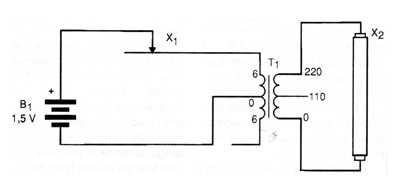
The circuit simply consists of a transformer, a fluorescent lamp and one or two common batteries. In the transformer we apply a low voltage in the primary winding from one or two batteries. This voltage rises, and in the secondary we get hundreds of volts, enough to produce flashes of a common fluorescent lamp.
Note that this process of energy transformation is dynamic, that is, the current must have sudden variations, which are achieved by rubbing the wire in a file. Otherwise, by directly connecting the wire to the transformer, for example, as no current variations occur, nothing happens.
In figure 1 we have the complete circuit diagram that we use in the experiment.
In Figure 2 we have the actual arrangement of the components used.
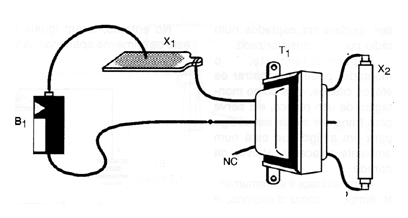
The cell must be large, because as we need a current something intense, a small pile would quickly drain. Two or four batteries can also be used in series, with greater "power" for the circuit.
The transformer can be of any type that has a high voltage winding (110 V or 220 V or double) and secondary voltages between 4 and 12 volts with central plug or not, and currents from 100 mA.
The fluorescent lamp can be of any type, including those that are already too weak to light up in the normal electrical installation. Lamps above 20 watts, however, may light up with more difficulty.
X1 is a common flat file in which we rub the tip of the wire that is welded on the positive pole of the pile.
To do the experiment just rub the yarn in the file. The lamp should flash on each wipe, indicating the high voltage induction on the transformer. Be careful not to touch the wires of the fluorescent because even when powered by batteries, the transformer generates high voltage and the shock is not weak!
Do not let the wire permanently lean against the file, as this does not induce current in the fluorescent lamp, causes the battery to deplete quickly. You can use this device as a telegraph or optical beacon by installing the lamp in a location that can be seen from a distance.
MATERIAL LIST
B1 - 1.5 to 3 V - 1 or 2 large cells
X1 - Flat file (flashing switch - see text)
T1 - Transformer with primary of 110 or 220-V and secondary of 6 + 6 V x 300 mA - see text (this transformer will work inverted, because the primary will be secondary)
X2 - 4 to 20 watt fluorescent lamp - see text
Wires, welding, etc.


