
This is a useful tool for those who work with the electricity grid, such as electricians. What we describe is a simple voltmeter that can tell whether the voltage of a socket is 110 V or 220 V, or if there is no voltage.
Extremely simple, this instrument does not require external power supplies and can be mounted in a small plastic box, which facilitates its transport.
In figure 1 we have the complete diagram of this apparatus and figure 2, the actual appearance of the assembly.
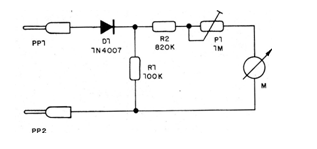
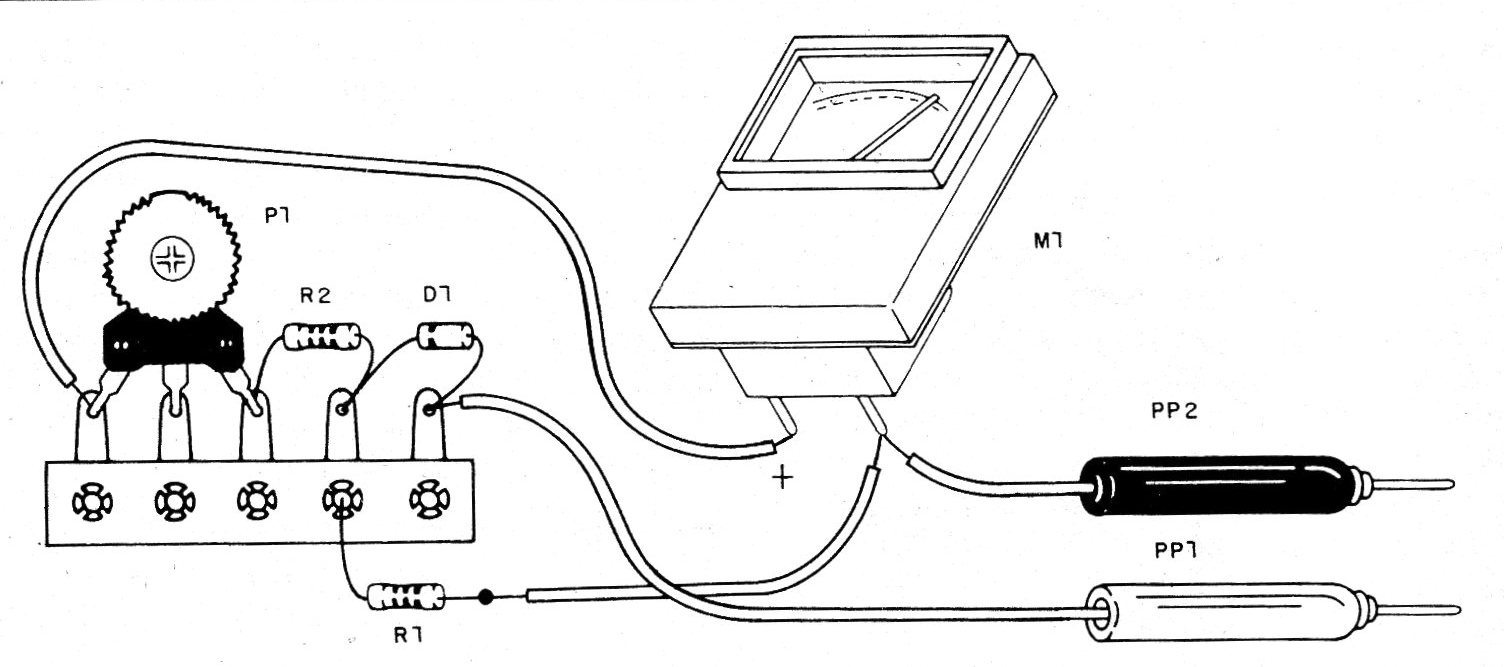
The instrument is a microammeter of approximately 200 uA, which can be a VU-meter of stereo whose scale will be modified.
The only adjustment is the trimpot and the few elements consist of 1/8 W resistors and a diode, which can be either 1N4007 or equivalent, such as BY127.
TEST AND USE
To test the instrument, simply connect the test leads to a known voltage socket (110 or 220 V).
Then simply adjust P1 so that the needle marks the corresponding tension on a scale.
This scale can be established by yourself, which will then fix the point corresponding to 110 or 220 V and then find the other one, remembering that there is a direct proportion between the needle deflection and the tension.
To use, it is only necessary to touch the probes at the points where the voltage is to be checked.
If the instrument does not adjust, in view of its characteristics, exceeding the end of scale, even with 110V, increase P1 to 2M2.
We also recall that, once adjusted for alternating voltages, the reading of continuous voltages will not be accurate, not the established scale.
MATERIAL LIST
D1 - 1N4007 or equivalent - silicon diode
M1 - 200 uA microammeter
R1 - 100k - resistor (brown, black, yellow)
R2 - 820k - resistor (gray, red, yellow)
P1-1M trimpot
Miscellaneous: box for mounting, diodes, solder, bridge of terminals etc.


