
Signal injectors are useful devices for locating defects in radios, recorders, amplifiers or any other type of circuit that works with audio signals. The injector we describe is characterized by its simplicity, low cost and even improvisation of a coil that can be wrapped in a common nail.
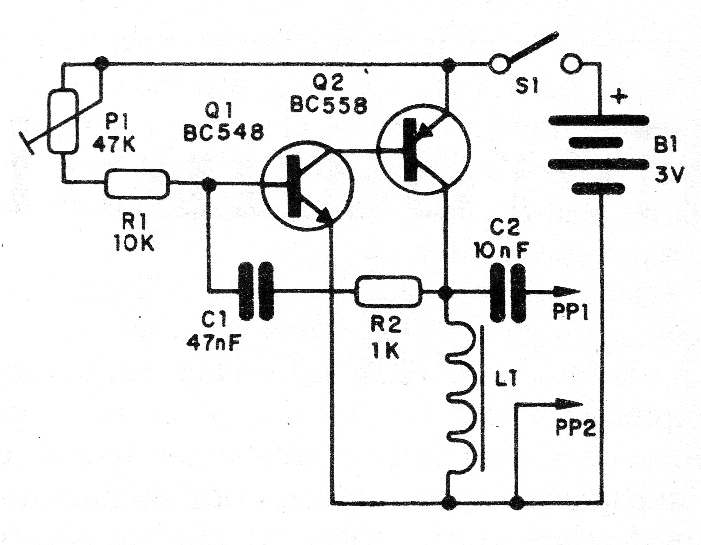
With it, you can easily locate problems in your projects or in audio equipment in general if you plan to go to the repairing technician activity. Powered by only 3 V, of two small batteries, this injector provides a powerful audio signal capable of exciting most common circuits. In figure 1 we have the complete diagram of the injector.
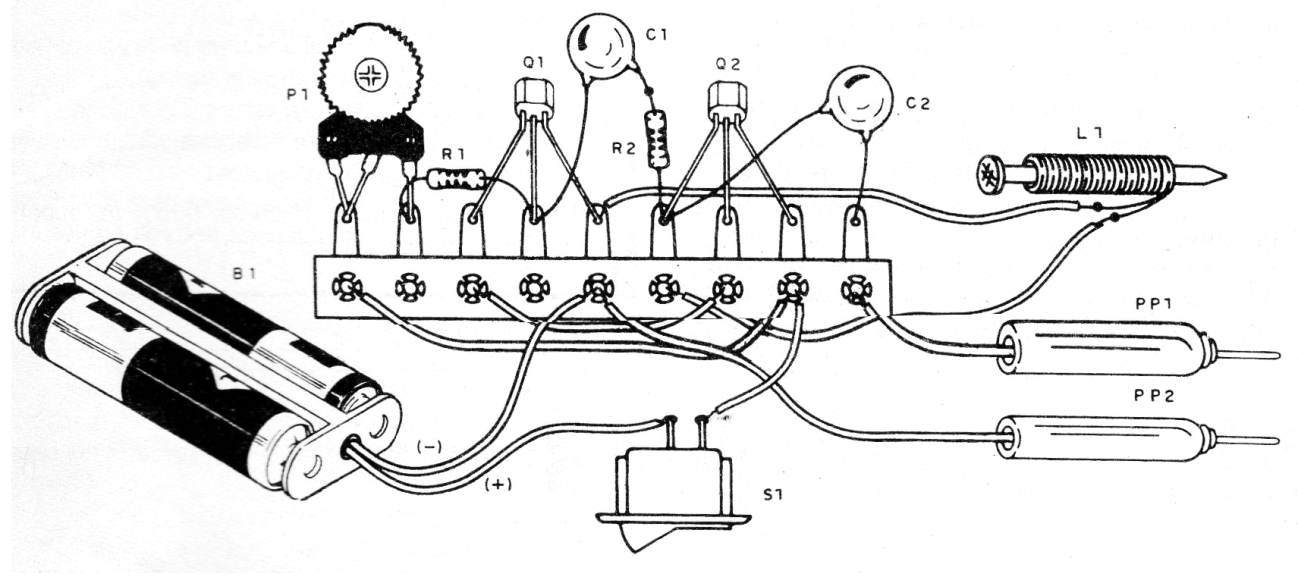
In figure 2 we have the assembly made on a strip of insulated terminals. Of course, the most skilled readers can do the printed circuit board assembly.
The circuit consists of an oscillator whose frequency can be set in the trimpot and depends on C1. You can change the trimpot by a fixed resistor if the frequency produced is not important. Use a 56k or 47k resistor.
The load coil consists of 100 to 300 turns of fine wire (32 AWG) on a nail 2 to 3 cm long. Transistors are commonly used and probes must have different colors. You can use a probe and an alligator grip for ease of use.
To use, inject the signal by touching the probe at the points on the circuit where it is to be amplified. The black tip or claw should be on the ground the negative of the circuit in test.
Material list
Q1 - BC548 - general purpose NPN transistor
Q2 - BC558 - general purpose PNP transistor
L1- coil - see text
S1- Single switch
B1- 3 V- 2 small batteries
P1- 47k - trimpot
R1 - 10 k ohm x 1/8 W - resistor - brown, black, orange
R2 - 1k ohm x 1/8 W- resistor - brown, black, red
C1 - 47 nF- ceramic capacitor
C2 - 10 nF- ceramic capacitor
PP1, PP2- red and black probes
Miscellaneous: terminal bridge, battery holder, nail, wires, solder, etc.


