
We describe a very small and simple rhythmic light system, which can be used on low power devices such as FM radios and recorders. A neon lamp will blink to the rhythm of the music played. This is a "mini" version of higher power projects which uses ordinary light bulbs.
The circuit works with a small transformer which converts the music low-voltage peaks, applied to a loudspeaker, into high-voltage peaks capable of driving a small neon light. As the power to feed the lamp comes from the audio signal itself, the circuit does not need power.
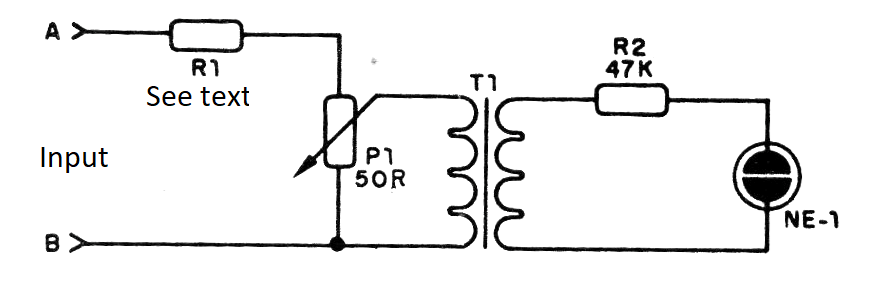
A current limiter resistor is used to avoid overload in case the amplifier has a higher power. So, for powers up to 1, use a 10 ohm resistor, for powers from 1 to 5 W, use 22 ohms and above that, 47 ohms. In Figure 1, we have the complete diagram of the apparatus.
The actual appearance of the assembly is shown in Figure 2.
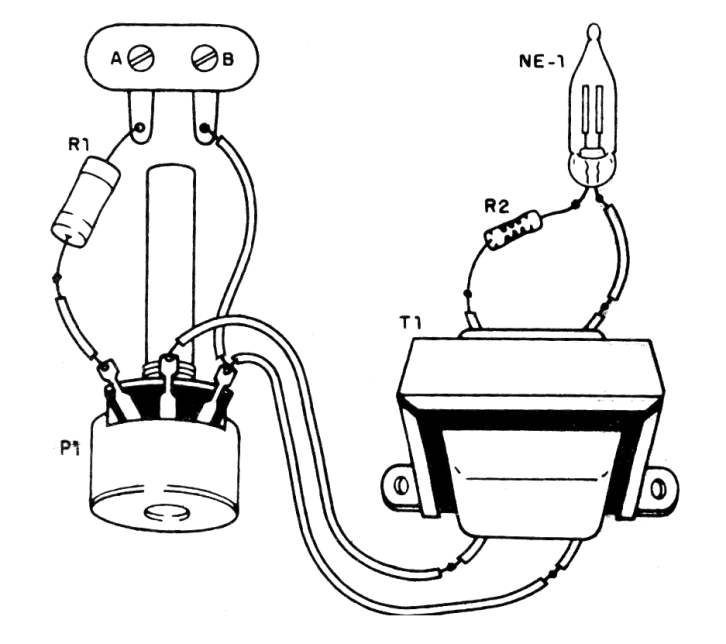
The transformer can be any small transformer used in primary power supply of 110 V or 220 V and the secondary of 5 to 12 V with current from 50 to 250 mA. The neon lamp is of the type without internal resistor, like the NE-2H.
The potentiometer sets the operating point according to the volume of the played sound. The circuit is connected to the wires which goes to the speaker of the unit.
Material list
NE-1 - Common neon lamp - NE-2H or equivalent
T1- Transformer - see text
R1- Resistor from 10 to 47 ohms - see text
R2 - 22 k ohms at 47 k ohms x 1/8 W - resistor - red, red, orange or yellow, violet, orange
P1 - 50 or 100 ohm wire potentiometer
Miscellaneous: wires, welding, box for assembly.


