
In many applications where a light sensor is required the LDR is chosen for its sensitivity and low cost. However, in the absence of an LDR we can use a phototransistor, but for this we need to modify its mode of operation with an increase in sensitivity.
The circuit we present is intended to allow a common photo transistor to be used instead of an LDR in applications where the power is supplied by direct voltage and does not exceed 12 volt. Using a high-gain Darlington transistor (30,000) we have increased the sensitivity of a phototransistor so that it behaves closely with an LDR in common applications. In figure 1 we have the circuit used for this purpose.
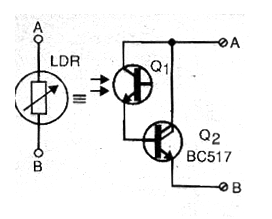
In figure 2 we have the arrangement of the components used in a terminal strip.
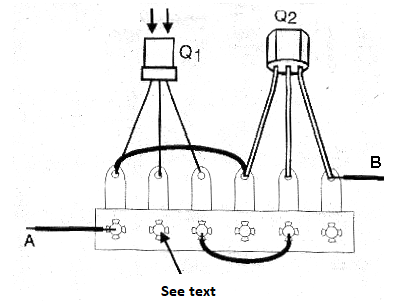
Note that the phototransistor used has its base switched off, which is common in this type of application. Many phototransistors are actually sold with only two terminals (the base is cut off) providing that they will not be used with connection to the base.
To try the circuit look for an application where a common LDR is used and make the replacement. Note the polarity since the point A should work with a positive voltage with respect to B. In place of the Darlington BC517 transistor the reader can use two BC548 in the equivalent connection.
MATERIAL LIST
Semiconductors:
Q1 - any photo-transistor
Q2 - BC517 - Darlington small power NPN transistor
Several:
Terminal strip, wires, etc.


