How to generate electricity from two common coins? If the reader thinks this is impossible, it is because he does not know this project, ideal for demonstrations in science fairs, classes or to be presented as school work (STEM).
With little material it is possible to carry out an experiment that shows how the chemical reactions release energy in the form of electricity and this in a totally harmless way.
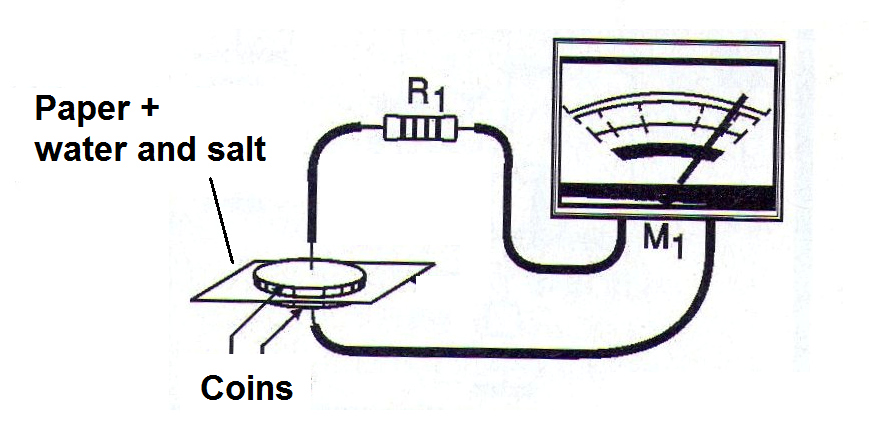
What we do is to place between two coins of different types and metals, a piece of cloth or porous paper dipped in water and salt.
The reaction that occurs releases enough electrical energy to move the pointer of an indicating instrument (galvanometer or analog multimeter).
Depending on the coins used, we may have different degrees of instrument pointer deflection, indicating that different voltages are being generated with a higher or lower energy release.
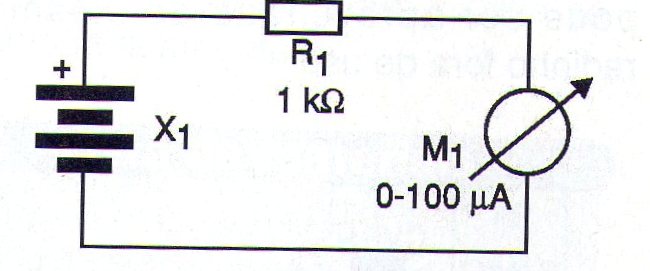
In figure 1 we have the diagram of the apparatus used in this experiment.
The actual arrangement of the components is shown in figure 2.
The resistor R1 is optional, serving only to avoid excessive current in the indicating instrument. The coins can be of any type, being an old one of silver with one of aluminum, are those that better results arriving to "generate" voltages of more than 1 volt.
To perform the experiment dissolve a spoonful of salt in a glass with half water. Then wet a sheet of porous paper (a paper napkin, for example) or fabric in that solution and place it between two coins.
Then lay the wires on these coins. If the instrument needle moves to the opposite side than expected, reverse the connecting wires.
The greater the deflection, the more energy is being produced. Over time the energy "decreases", in which case we should change the wet paper to another "new" wet in the same solution.
When you finish the experiment, clean the coins well, as they can be "corroded".
MATERIAL LIST
X1 - Stack of coins - see text
R1 - 1 k ohm - resistor - brown, black, red
M1 - A common microammeter of 0-100 uA or nearby, or a common multimeter
Miscellaneous:
Porous paper or cloth, water and salt, glass, yarns, coins, etc.


