
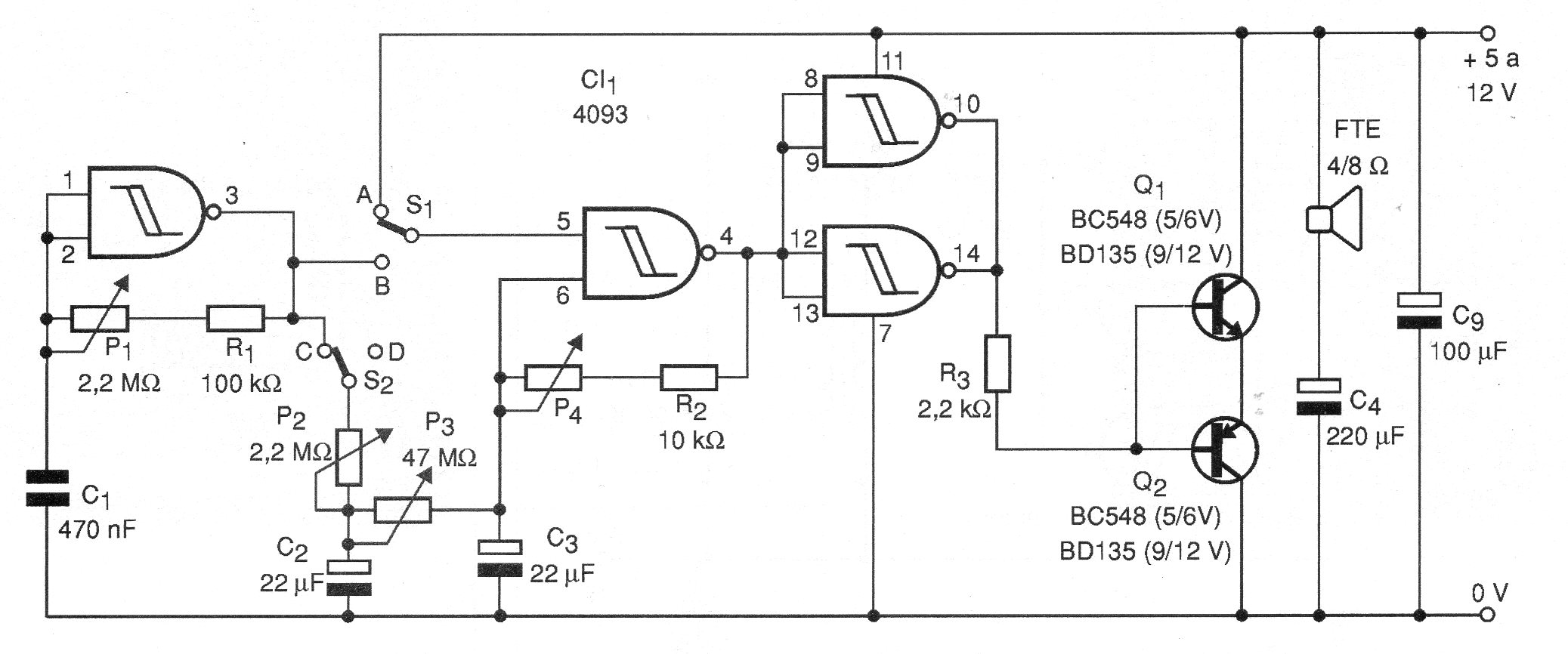
It is an interesting toy containing several potentiometers and keys allowing the children to create the most diverse sound effects. The complete circuit is given in figure. This circuit can also be used in parties and radio stations to create some effects or for calls.
In this circuit we have two interdependent oscillators formed around two of the NAND ports of the 4093. The first oscillator generates flashes that are controlled by P1. The switches S1 and S2 apply the signal from this oscillator to the next oscillator which generates an audio tone whose frequency is controlled by P4.
When the switch S2 is in the C position the signal of this oscillator passes through two other potentiometers P2 and P3 that form a network able to control the modulation of the second oscillator. The adjustment of all the potentiometers combined allows the creation of different types of sounds. The final signal obtained is digitally amplified by the other two ports of the 4093 and applied to a power stage with complementary transistors. This step provides a good audio signal to a small speaker.
The circuit can be powered with voltages from 6 V obtained from 4 batteries. For higher voltage source must be used and the transistors must be replaced by those indicated in the diagram, being mounted on heatsinks.
Material list
CI-1 - 4093 - Integrated Circuit CMOS
Q1 - BC548 or TIP31 (depending on voltage)
Q2 - BC558 or TIP32 (depending on voltage)
P1 - 2.2 M ohm - lin or log potentiometer
P2 - 22 k ohm or 47 k ohm - lin or log potentiometer
P3 - 47 k ohm - lin or log potentiometer
R1 - 100 k ohm x 1/8 W - resistor - brown, black, yellow
R2 - 10 k ohm x 1/8 W - resistor - brown, black, orange
R3 - 2.2 k ohm x 1/8 W - resistor - red, red, red
C1 - 470 nF - ceramic or polyester capacitor
C2 - 22 uF x 12 V - electrolytic capacitor
C3 - 22 nF - ceramic or polyester capacitor
C4 - 220 uF x 12 V - electrolytic capacitor
C5 - 100 uF x 1/8 W - electrolytic capacitor
S1, S2 - 1-pole switches x 2 positions
FTE - 4 or 8 ohms - speaker of any size - great for 12 V
Several:
Printed circuit board, mounting box, batteries or power supply, wires, buttons for potentiometers, welding, etc.


