
This circuit can be used in the car or even in the home, together with a 12 V source with at least 1 A for special light effects accompanying the sound. With it, a 12 V lamp will blink in the rhythm of the music played by your sound equipment.
The sensitivity of the device is very good and even the sound of a small portable radio is enough to excite the circuit. In this case, the signal can be removed from the headphones jack or from the loudspeaker itself.
The circuit can power incandescent lamps up to 1 amp and has a sensitivity control.
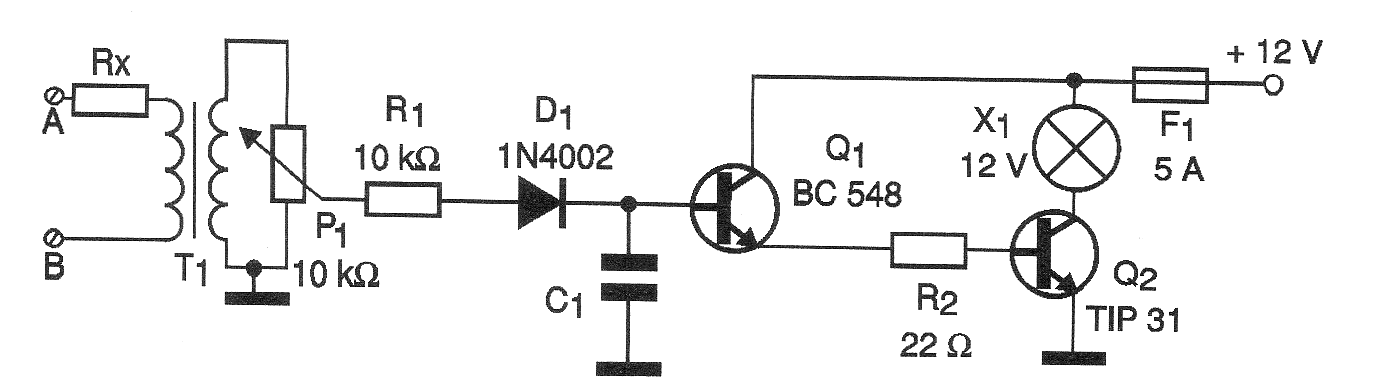
The capacitor C1, with values between 10 nF and 220 nF, determines the frequency response of the circuit to the sounds. At higher values, the circuit tends to respond more to bass sounds.
Mounted on a small module, the device can be used in the car producing a very interesting light effect. In figure 1 we have the complete diagram of the apparatus.
In Figure 2 we have the arrangement of the components on a small terminal strip, but nothing prevents the more skilled readers from mounting on a printed circuit board.
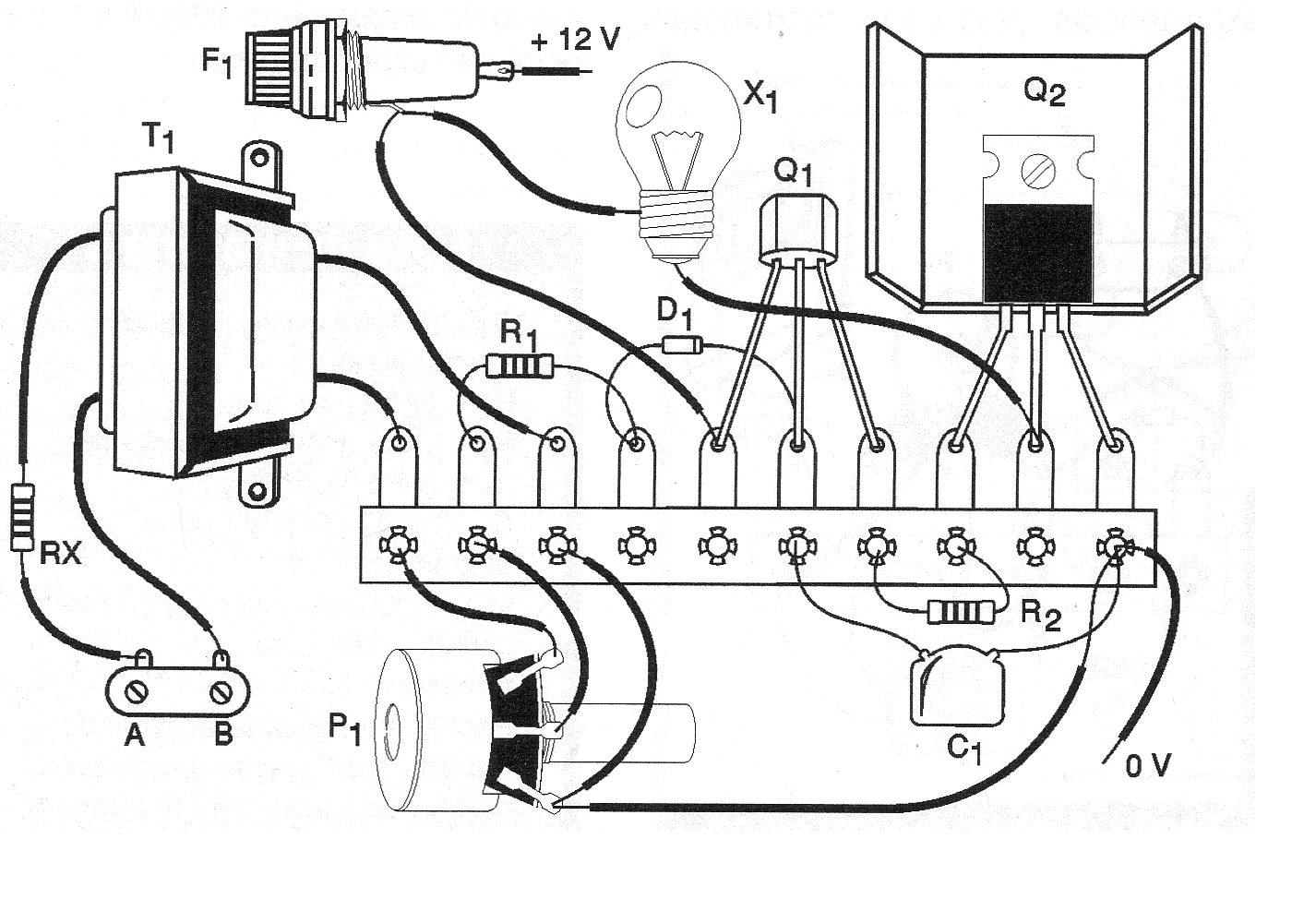
Note that transistor Q2 must be mounted on a heatsink that consists of a folded "U" shaped metal blade. For signal input common wires may be used in a final assembly or if the reader prefers a terminal bridge with screws.
The transformer can be any one used in primary voltage sources of 110 V or 220 V (to be connected to the potentiometer) and secondary of any voltage between 4 and 12 V with current between 100 and 500 mA.
The Rx resistor must be reduced if the power of the sound source is less than 1 W (radios, CD players, or recorders). The other resistors are 1/8 W and the capacitor C1 can be ceramic or polyester.
The common potentiometer and the appliance do not need a general switch because when the sound is switched off at the input, the consumption drops to zero. Diode D1 accepts equivalents such as 1N4004, 1N4148, etc.
To experiment, connect the speaker wires of a stereo, the output of a portable radio, or the handset output to inputs A and B. Connect points C and D to power.
Set the volume to the desired volume and set P1 to the lamp blinking to the rhythm of the song. If you can not do this, reduce the Rx value.
Check the operation of the appliance, close it in a box or install it definitively.
MATERIAL LIST
Semiconductors:
Q1 - BC548 or equivalent - general purpose NPN transistor
Q2 - TIP41 - NPN power transistor
D1 - 1N4002 or equivalent - silicon diode
Resistors: (1/8 W, 5%)
Rx - 47 ohm / 1 W - yellow, violet, black
R1 - 10 k ohm - brown, black, orange
R2 - 22 ohm - red, red, black
P1 - 10 k ohm - potentiometer
Capacitors:
C1 - see text
Miscellaneous:
T1 - Power Transformer - see text
X1 - 12V up to 1 A - common lamp
F1 - 5A - fuse
Terminal srtrip, screw bridge, mounting box, Q2 heat radiator, fuse holder, potentiometer knob, wires, solder, etc.


