
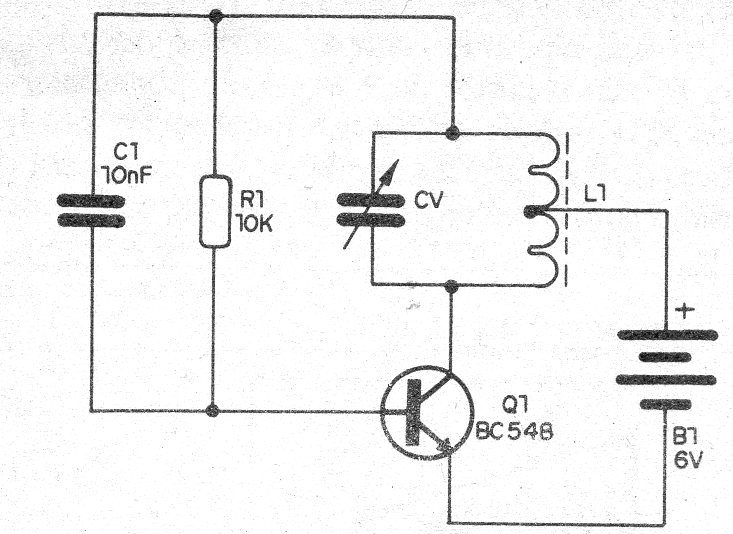
This experimental Hartley oscillator produces signals in the range of 500 kHz to 1.5 MHz, serving to study how this type of oscillator works and also the properties of the resonant circuits. Your signal can be picked up on a mid-wave radio.
This oscillator emits its signal to a medium-wave radio at a distance that can reach a few meters.
With it we can study how this type of oscillator works and also the resonant circuits.
In figure 1 we have its complete circuit.
The assembly in a protoboard is done as shown in figure 2.
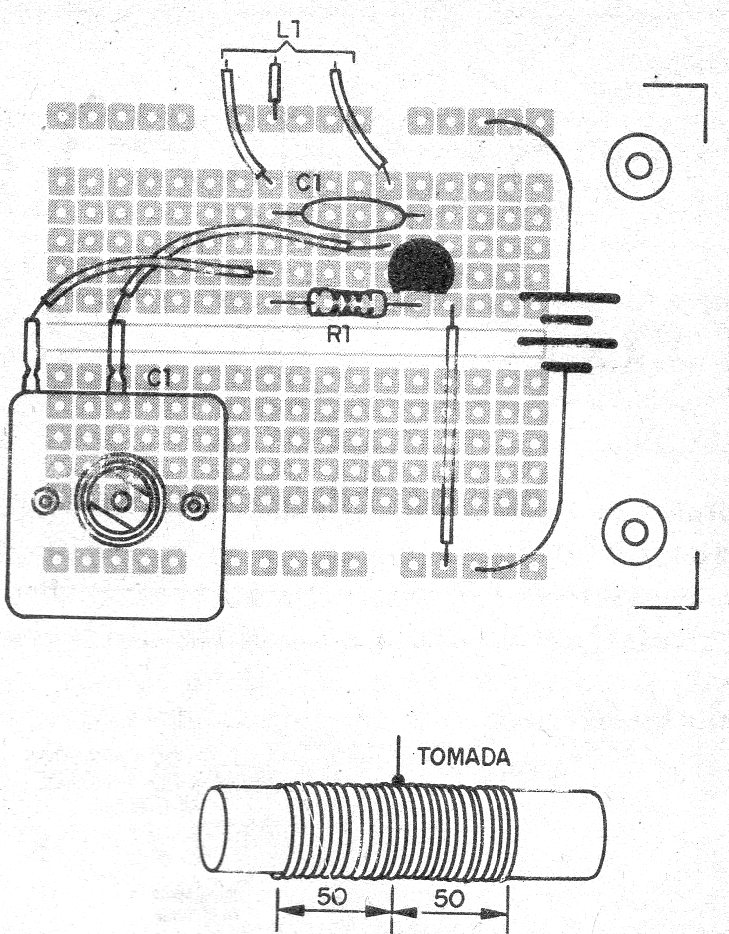
The coil is formed by 40 + 40 turns of thickness between 28 and 32 in a ferrite rod.
The variable capacitor can be taken advantage of an out-of-use medium-range radio.
The resistor is 1/8 W and the capacitor must be ceramic.
An antenna, formed by a piece of wire from 1 m to 5 meters in length, can be connected to the collector of the transistor.
To use, tune an out-of-station average radio wave in the vicinity and adjust CV to pick up the oscillator signal.
Material list
Q1 - BC548 - NPN general purpose transistor
L1 - Coil - see text
CV - variable capacitor - see text
B1 - 6 V - 4 batteries
C1 - 10 nF - ceramic capacitor
R1 - 10 k ohms - resistor - brown, black, orange
Several:
Protoboard, battery holder, wires, solder, etc.


